
Reviewed · LITTLE INDIA & KAMPONG GLAM TOURS
Kampong Glam and Little India Join-in Walking Tour
A good neighborhood tour should teach you to look. This join-in walk strings together Kampong Glam and Little India in one smooth circuit, with plenty of street corners and real landmarks like Sultan Mosque and Sri Veeramakaliamman Temple. It’s also the kind of tour where you come away with names, context, and practical ways to keep exploring after you’re done.
Two things I like a lot: first, the guide-led mix of classic and everyday places, from Haji Lane and Arab Street to Tekka Centre’s market-and-hawker setup. Second, the tone—serious explanations, but given in a way that helps you understand what you’re seeing, including stories behind sites like the Former House of Tan Teng Niah and the Malay Heritage Centre area. The biggest drawback to consider is that admission isn’t included for some stops, so you may want to plan for optional entry costs if you decide to go inside.
In This Review
- Kampong Glam and Little India: Two Neighborhoods, One Singapore Feeling
- What You Get: Route, Stops, and a Guide Who Keeps It Moving
- Meeting at Bugis, Starting at 9:00am, and Finishing in Little India
- Haji Lane, Arab Street, and Bussorah Street: Where Street Art Meets Islamic Landmarks
- Sultan Mosque: The Landmark Stop You’ll Actually Remember
- Gedung Kuning and Istana Kampong Glam: Two Heritage Buildings Without the Hustle
- Race Course Road and Tekka Centre: Market Life You Can Use After the Tour
- Former House of Tan Teng Niah: A Painted Reminder That History Lives in Plain Sight
- Sri Veeramakaliamman Temple and Little India Arcade: Faith and Architecture Close Together
- Campbell Lane: Ending on a Street You’ll Want to Continue Wandering
- Price and Value: Is $84.75 Worth It?
- Who This Tour Fits Best (and Who Might Want Another Option)
- Quick Practical Tips So You Don’t Miss the Good Stuff
- Should You Book This Kampong Glam and Little India Join-in Walking Tour?
- FAQ
- How long is the Kampong Glam and Little India join-in walking tour?
- Where does the tour start and where does it end?
- What time does the tour begin?
- Is admission to attractions included?
- What ticket format do I need?
- How large is the group?
- What fitness level do I need?
- Can I cancel for a full refund?
Kampong Glam and Little India: Two Neighborhoods, One Singapore Feeling
Kampong Glam and Little India are often talked about as separate areas, but this tour treats them like one connected story. You start with the historic Malay and Arab quarter and its cultural landmarks, then shift to the Indian community side with temples, painted heritage buildings, and market life.
That shift matters. Singapore’s multicultural identity isn’t just a slogan—you can feel it in the street layout, the shops, the places of worship, and the food stops. A walking tour is a smart way to pick up those patterns fast, without waiting in lines or cramming your schedule with taxis.
What You Get: Route, Stops, and a Guide Who Keeps It Moving
This is a 3 hours 30 minutes guided walk. It’s a join-in style tour with a max group size of 15, which is small enough that you can actually hear explanations and ask questions without feeling lost in a crowd. You also get an English-speaking licensed tourist guide and a mobile ticket, so you’re not stuck hunting for paper.
A standout from the best feedback is the guide’s ability to keep the pace comfortable and still pack in meaningful context. The name that comes up often is Charles—praised for being well informed, answering questions, and even helping with topics beyond the tour. If you’re the type who likes to ask why things look the way they do, that matters.
Meeting at Bugis, Starting at 9:00am, and Finishing in Little India
You start at Bugis and finish in Little India. The start time is 9:00am and the endpoint is Little India, Singapore.
Why this matters: starting near Bugis means you’re well-positioned for transit connections before and after the tour. Ending in Little India is also handy if you want to keep going—because once the tour drops you near temples and arcades, you’re already set up for a second walk or a meal.
The itinerary is built around walking plus some short transit. One of the most helpful comments on pacing is that the route moves through Kampong Glam first, then continues toward the Indian communities (including an MRT hop). That keeps the 3.5 hours from turning into a long slog of straight-line walking.
From Tekka to the Sultan Mosque, more quarter time
Haji Lane, Arab Street, and Bussorah Street: Where Street Art Meets Islamic Landmarks
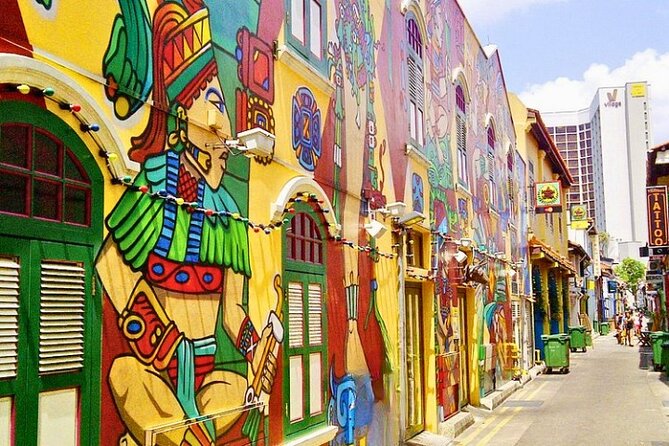
Your Kampong Glam portion begins with Haji Lane, a classic alley known for its colorful street art and small indie shops and cafés. It also has a historical angle: it was once linked to Muslim pilgrims lodging on the route to Mecca. That detail changes how you look at the alley. You’re not just seeing photos you’ve already scrolled past.
Next comes Arab Street. This area is centered around the Sultan Mosque, and it’s described as a historic road with Islamic heritage, textile shops, and Middle Eastern eateries. The practical value here is learning how the streets wrap around the mosque area, so you can find your way later without needing a map app every two minutes.
Then you move to Bussorah Street, a pedestrian-friendly lane right in front of Sultan Mosque with heritage shophouses and Middle Eastern cuisine and souvenirs. This part is good for getting your bearings quickly: you see how the neighborhood blends religious architecture, shopping streets, and food culture.
Sultan Mosque: The Landmark Stop You’ll Actually Remember
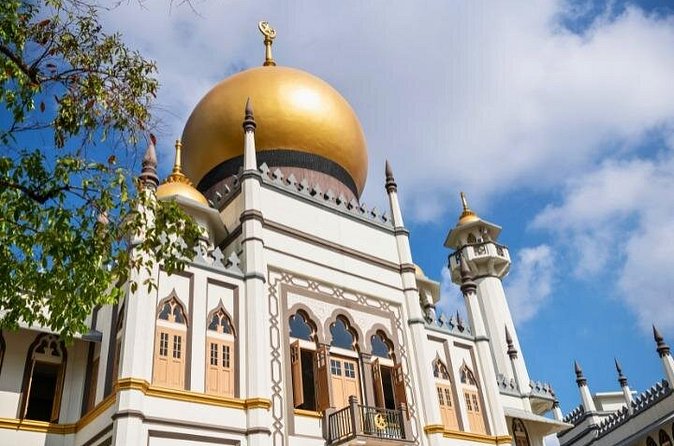
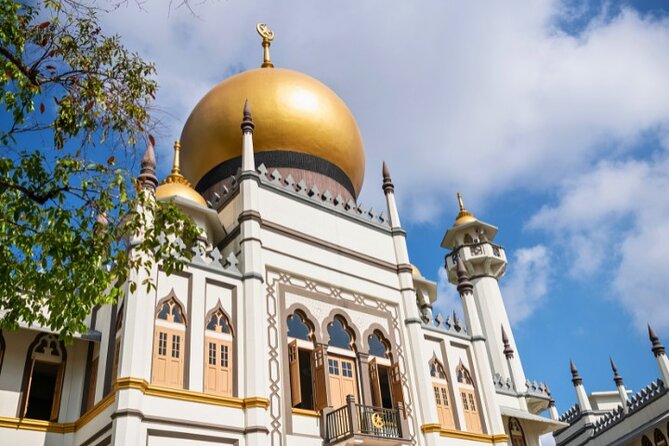
Sultan Mosque (Masjid Sultan) is the big icon of the area. The tour provides key context: built in 1824 for Sultan Hussein Shah, Singapore’s first sultan, it’s one of the city’s most recognizable religious landmarks.
Here’s what to watch for during the stop: don’t treat it like a quick photo-and-go. Use the time to notice how the surrounding streets funnel toward the mosque. A lot of visitors only register the building; the tour helps you understand why this mosque sits at the center of Kampong Glam’s identity.
Also good news: the stop is listed as free, so you’re not paying for a timed ticket just to appreciate the setting.
Gedung Kuning and Istana Kampong Glam: Two Heritage Buildings Without the Hustle
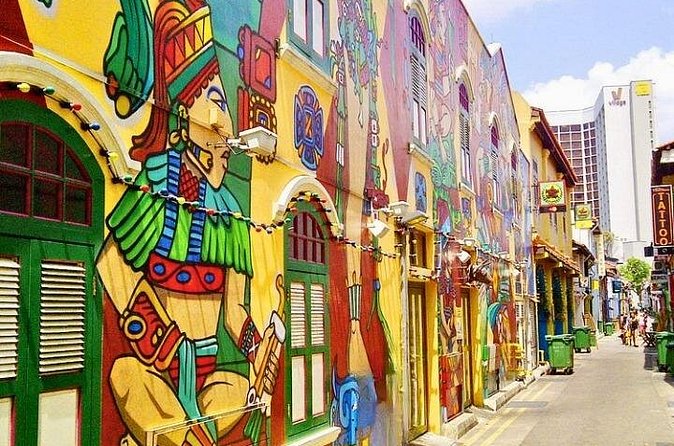
After the main mosque area, you get two more heritage points that help explain how royal and community life overlapped in this district.
First is Gedung Kuning, meaning Yellow Mansion. The tour frames it as a heritage building from the 1850s that once served as a royal residence for Malay nobility. Today, it houses a restaurant and cultural spaces (so it’s not just a stone façade—you can often experience it as part of daily life).
Then comes Istana Kampong Glam. This palace was once the royal residence of Sultan Hussein Shah and descendants. It now houses the Malay Heritage Centre, where you can expect exhibitions related to the area’s heritage.
In both cases, the tour lists admission as not included. So think of these as guided orientation stops: you get the story, then decide whether you want to pay to go inside.
Shophouse streets reward slow feet, keep going
- Singapore: Private Walking Tour with a Local★ 4.7 · 410 reviews
- Private Customised Singapore Walking Tour★ 5.0 · 370 reviews
- Singapore: Chinatown, Little India, Arab Street Walking Tour★ 4.9 · 207 reviews
- Singapore: Chinatown and Little India Guided Walking Tour★ 4.8 · 190 reviews
Race Course Road and Tekka Centre: Market Life You Can Use After the Tour
When the route turns toward Little India, it uses street geography in a clever way. Race Course Road is named for the Serangoon Road Race Course, Singapore’s first horse racing track established in 1842 at what is now Farrer Park. The tour also notes that today it’s a lively street in Little India.
That historical detail is more than trivia. It helps you understand how street names preserve older city functions, even after the neighborhood changes. You can look at the road and “read” it as a timeline.
Then you hit Tekka Centre (Tekka Market). This stop is especially useful if you want the real texture of local food and shopping. Tekka is described as a multi-use complex with a wet market, a hawker centre, and shops. It was originally built in 1915 and reconstructed at the current site in 1982.
Two practical tips for this section:
- If you’re hungry, you’ll have options without needing a big plan.
- Even if you don’t eat, this is where you’ll notice how the market layout supports fast browsing and constant movement.
This stop is free to visit, and the tour gives you context so Tekka doesn’t feel like an overwhelming food hall—you’ll know what you’re looking at.
Former House of Tan Teng Niah: A Painted Reminder That History Lives in Plain Sight
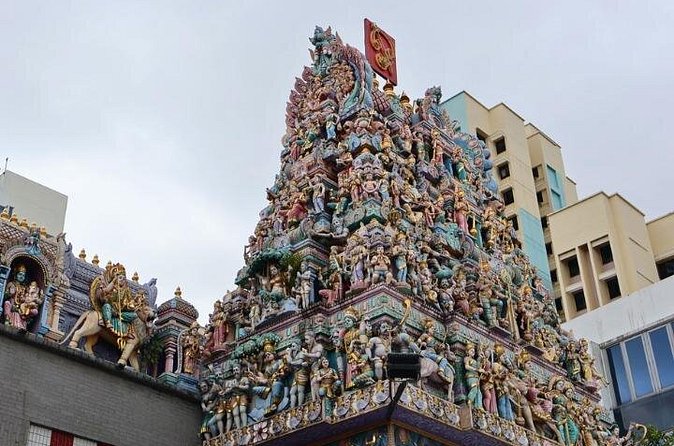
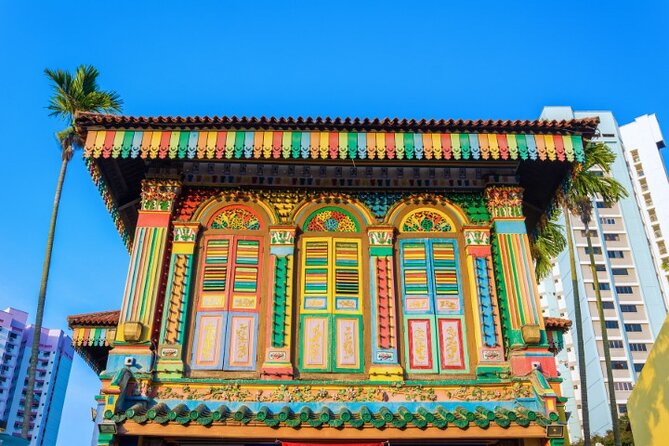
Next is the Former House of Tan Teng Niah. This is a vividly painted Chinese villa built in 1900 by confectionery tycoon Tan Teng Niah. The tour also points out that it sits in the heart of Little India and is the neighborhood’s last surviving conserved Chinese villa (the description cuts off, but the core idea is clear: it’s rare, intact, and historically significant).
Why I like including this stop: it prevents Little India from becoming only temples and shopping. You also see how business wealth and everyday architecture shaped the neighborhood’s character—and how those buildings can survive inside modern streets.
This stop is short (about 5 minutes) and admission isn’t included, so treat it as a guided look from outside. The value is learning what you’re seeing before you move on.
Sri Veeramakaliamman Temple and Little India Arcade: Faith and Architecture Close Together
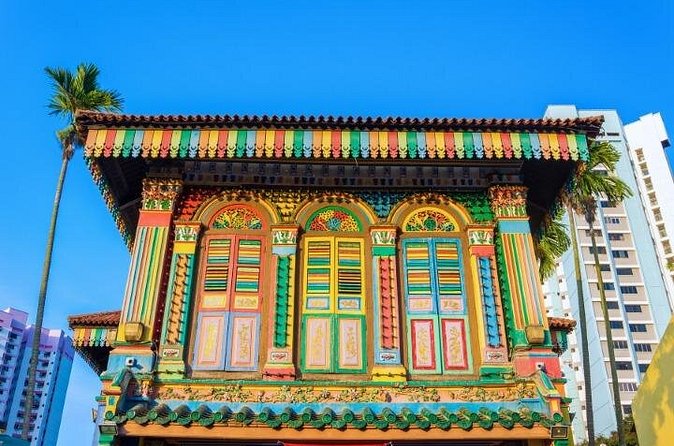
Sri Veeramakaliamman Temple is one of the tour’s key cultural anchors. The tour explains it as one of Singapore’s oldest Hindu temples, established as a shrine in 1855 and later rebuilt in 1881 by Indian pioneers on Serangoon Road in Little India.
A good tip: slow down here even if other parts of the tour feel rushed. Temples reward attention. The guide’s context helps you connect the building to a timeline—1855 first shrine, 1881 rebuild—so you don’t only see an impressive façade.
Next is Little India Arcade, a shopping complex in conserved neoclassical shophouses built in 1913 and officially opened in 1995. The description notes development by Hindu Endowments (the rest of the name is truncated), but the takeaway is clear: this is heritage buildings repurposed for modern shopping.
Admission isn’t included for this stop, which usually means you’ll look around rather than pay for an exhibit. It’s still worth it because you learn how conservation can keep neighborhood identity alive while allowing everyday commerce.
Campbell Lane: Ending on a Street You’ll Want to Continue Wandering
Your final segment is Campbell Lane, described as a vibrant pedestrian street in Little India and linked to older livestock trade. The description also says it has transformed into a lively pedestrian hub.
That’s a perfect way to end. You finish at a place where it’s easy to keep moving on your own—grab a snack, browse shops, or just walk the lane again now that you’ve learned the neighborhood’s basic story.
Price and Value: Is $84.75 Worth It?
At $84.75 per person, this isn’t a “cheap” add-on. But it also isn’t priced like a private car tour or an all-day museum pass. For the amount of ground it covers—Kampong Glam + Little India landmarks, multiple street stops, and time at major icons—this is fairly positioned for a licensed guide experience.
Here’s where the value actually comes from:
- You’re paying for guided context at places like Sultan Mosque and Sri Veeramakaliamman Temple, where a quick guidebook read can’t match walking the streets and hearing the stories.
- You get a structure that prevents decision fatigue. Instead of guessing what to see in two neighborhoods, you follow a route that makes geographic sense.
- Group size is limited to 15, which helps keep the tour from feeling like a cattle line.
The main value trade-off: since admission fees aren’t included for certain heritage sites, you may spend extra if you choose to enter places like the Malay Heritage Centre area. If you prefer “see from outside” sightseeing, you can keep costs controlled.
Who This Tour Fits Best (and Who Might Want Another Option)
This tour works well if you:
- Like street-level travel over jump-on-jump-off bus routes.
- Want cultural context, not just photo stops.
- Enjoy markets and heritage buildings side-by-side.
- Ask questions and want a guide to connect dots.
It’s also fine for moderate walking needs. The tour lists a moderate fitness level requirement, and the total time is 3.5 hours, which is manageable for many visitors—especially with breaks at each stop.
If you have very limited mobility or you want a slower, sit-down, low-walking experience, you might find it a bit fast. It’s also not a food-focused tour in the data provided. You’ll see market culture, but you should treat meals as optional add-ons rather than a guaranteed sampling plan.
Quick Practical Tips So You Don’t Miss the Good Stuff
- Bring water. Even if the weather is mild, you’ll cover a lot of streets.
- Wear shoes that handle pavement and pedestrian lanes. Some segments are short but frequent turns.
- Keep a small buffer for optional entries. Since some stops have admission not included, you’ll want to decide on the spot.
- If your guide is Charles (or another guide with the same style), don’t be shy about questions. The tour rhythm is built for dialogue, not silent marching.
Should You Book This Kampong Glam and Little India Join-in Walking Tour?
Book it if you want a guided “two-neighborhood” Singapore experience that mixes heritage landmarks, street life, and market geography without making you plan every step. The strongest reason to say yes is the guide quality highlighted in feedback—especially the clear, helpful explanations and a pace that feels organized.
Skip or consider alternatives if you only want paid-entry attractions included, or if you prefer a totally self-guided tour. With admission not included at key stops, you’ll need to be comfortable choosing what to enter.
If your goal is to leave with a better understanding of how Kampong Glam and Little India function as living communities, this is a smart use of half a day.
FAQ
How long is the Kampong Glam and Little India join-in walking tour?
It runs for about 3 hours 30 minutes.
Where does the tour start and where does it end?
It starts at Bugis and ends in Little India, Singapore.
What time does the tour begin?
The start time is 9:00am.
Is admission to attractions included?
No. Admission fees are not included for entry or admission at some stops.
What ticket format do I need?
You get a mobile ticket.
How large is the group?
The tour has a maximum of 15 travelers.
What fitness level do I need?
The tour notes a moderate physical fitness level.
Can I cancel for a full refund?
Yes, you can cancel up to 24 hours before the experience start time for a full refund.
Walks That Earn the Humidity


Little India and Kampong Glam, Continued


Fresh Reviews from the Little Red Dot
- Night Safari Tickets with Tram Ride
★ 4.5 · 3 reviews - Singapore: Architecture and Food Tour with Tastings
★ 5.0 · 3 reviews - Singapore Private Full-Day Sightseeing Tour
★ 5.0 · 3 reviews - Private Chinatown Heritage Tour with Best 8 Local Tastings
★ 5.0 · 3 reviews
Little India & Kampong Glam Tours, compared.
 ★ 5.0Chinese, Indian & Arabic Quarters, Culture & Food TourFrom $148789 reviews
 ★ 5.0Chinatown, Little India, Kampong Gelam City Highlights TourFrom $80224 reviews
Chinatown, Little India, Arab Street Walking TourFrom $53207 reviews
 ★ 4.8Chinatown and Little India Guided Walking TourFrom $78190 reviews
 ★ 4.5Kampong Glam, Little India & Chinatown with Local Street Food TastingsFrom $17770 reviews
 ★ 5.0#instawalk: Bugis, Waterloo, Kampong GlamFrom $5660 reviews
 ★ 5.0Tasting Trails: Chinatown OR with Kampong Glam, Little IndiaFrom $6759 reviews
 ★ 5.05 hours Little India, Kampong Glam, Chinatown with 9 Food TastingFrom $14158 reviews
Browse the lists this tour appears in