
Reviewed · KATONG & PERANAKAN HERITAGE TOURS
The Peranakan Mansion – Experience Singapore’s Unique Culture
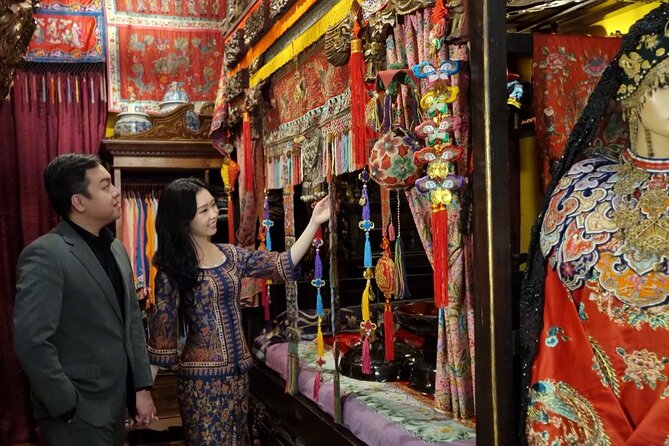
A shophouse museum with bite-size history. The Peranakan Mansion (by Straits Enclave) puts Singapore’s Peranakan Chinese story inside a conserved 1928 shophouse in Joo Chiat, and it turns heritage into something you can actually follow. I like that the visit starts with a Peranakan cultural talk, so the guided tour makes sense the moment you step inside.
My second favorite part is the food-and-drink add-on: you get to taste Peranakan kuehs and traditional tea during the experience. One consideration: the museum is on the second floor and you’ll need to climb about 20 steps, plus a flight of steps to reach that level from the main street.
In This Review
- Key Things to Know Before You Go
- A 1928 Shophouse Tells You the Story First
- What Happens in the 2-Hour Visit (Talk, Guided Tour, Kuehs, Tea)
- Entering the Second Level: Your Main Practical Challenge
- The Peranakan Houses: More Than Decor, Real Community Memory
- Tea and Kuehs: A Small Add-On That Makes the Whole Thing Stick
- Location in Joo Chiat: Why This Neighborhood Works for Culture
- Price and Value: Is $30.68 Worth It?
- Timing and What to Plan Around (Opening Hours + Best Use of Time)
- Practical Tips That Make the Visit Easier
- Should You Book The Peranakan Mansion?
- FAQ
- Where does the Peranakan Mansion tour start?
- How long is the experience?
- How much does it cost?
- What’s included besides the museum visit?
- Do I need to print a ticket?
- Is the museum on the ground floor?
- What are the opening hours?
- How many people are in a group?
- Can I get a refund if I cancel?
Key Things to Know Before You Go
- Joo Chiat location in a conserved 1928 shophouse: history you can see, not just read.
- Talk first, tour second: you’ll have context before artifacts start flying past.
- Peranakan kuehs and tea are part of the visit: it’s culture you taste, not just observe.
- Small-group feel: capped at 50 people, which helps the guide keep things clear.
- Second-floor access requires steps: plan footwear and pace accordingly.
A 1928 Shophouse Tells You the Story First
This experience is built around a simple idea: Peranakan culture isn’t something stuck in a book. It lives in homes, objects, and everyday habits, and that’s exactly what you see at the Peranakan Mansion in the Joo Chiat heritage district. The setting matters because the venue is a conserved Peranakan Chinese private museum in a 1928 shophouse. You’re not touring a plain gallery. You’re walking through a preserved home that helps you understand how people lived.
Joo Chiat is the kind of place where details add up. The whole point of bringing you here is to show Peranakan Chinese heritage in Singapore as the city kept changing fast around it. This is the “how did a community survive and adapt?” question, answered through rooms, displays, and guided explanation.
I also appreciate the practical flow. You’re greeted, oriented, then guided through what you’re seeing. That’s a good way to avoid the classic museum problem: staring at artifacts without knowing what you’re looking at.
What Happens in the 2-Hour Visit (Talk, Guided Tour, Kuehs, Tea)
The visit runs about 2 hours. It’s long enough to feel like a real mini-program, but short enough that it doesn’t eat your whole day in Singapore. It also works well if you’re doing multiple cultural stops and want something focused.
Here’s the rhythm you should expect:
1) A Peranakan cultural talk to set the frame
You start with an insightful talk that brings Peranakan Chinese culture into focus. Think of it as the map you’ll need before you start walking through the museum rooms.
2) Guided tour of the mansion
After the talk, you’ll follow a guide through the mansion and learn the history, stories, and meaning behind the artifacts and displays. This is where the experience shifts from “general culture” to “specific objects and the people behind them.”
3) Tasting Peranakan kuehs and traditional tea
Then you get the food component—authentic Peranakan kuehs (snacks) plus traditional tea. This is one of the most memorable parts because it turns what you learned into something you can connect with right away.
The overall value here is the combo. You’re not just paying to walk slowly and read labels. You’re paying for a sequence: context, storytelling, then taste.
Deeper into Katong tiles and Peranakan kitchens
Entering the Second Level: Your Main Practical Challenge
You’ll start at Singapore Peranakan Mansion – Peranakan Museum @ Joo Chiat by Straits Enclave at 283A Joo Chiat Rd, Singapore 427537. The experience ends back at the meeting point, so you’re not stuck figuring out how to get back across Joo Chiat with half your brain switched off.
The biggest practical consideration is vertical movement. The Straits Enclave museum space is on the second level of the Joo Chiat heritage shophouse. You’ll need to climb a flight of steps from the main street, and you should expect around 20 steps to reach the museum on the second floor. There’s no suggestion that an elevator is part of the setup, so treat the stairs as a real factor.
My tip: wear shoes you’re comfortable walking in, and don’t plan this as your first stop after a long flight day. The experience is relaxed, but your body still needs to get up there first.
The Peranakan Houses: More Than Decor, Real Community Memory
The heart of the experience is the way the museum uses a preserved home to tell the Peranakan story. When you hear Peranakan mentioned, it can feel like a label. This tour helps you understand it as a lived culture with specific roots and influences, and you’ll see how that history connects back to Singapore’s wider development.
The guided portion focuses on history and fascinating stories tied to what you see. That matters because Peranakan culture isn’t just “Chinese traditions in Singapore.” It’s a blend that shows up in objects, household life, and the way families expressed identity over time—especially as Singapore modernized quickly.
In plain terms, you’ll leave with better mental pictures of what Peranakan life looked like and why certain artifacts exist in the first place. This is the kind of museum that helps you stop seeing cultural heritage as static. It’s a reminder that culture changes with time, but it doesn’t vanish.
Tea and Kuehs: A Small Add-On That Makes the Whole Thing Stick
I’m a big believer in “memory anchored by taste.” This is one of those experiences that uses food in a smart, not-random way. You get to taste authentic Peranakan kuehs and enjoy traditional tea during the visit, which helps you connect the cultural talk and guided tour to something sensory.
You don’t need to be a foodie to enjoy this part. Even if you only take small bites, it creates a break from pure listening and looking. It also gives you a chance to slow down and actually notice what’s being explained, because now you have an experience-based reference point.
The reviews place strong emphasis on the tea and the quality of the afternoon-style pairing. That checks out with how the experience is designed: the food isn’t just an afterthought, it’s part of the storytelling rhythm.
Air-conditioned history, more halls to wander
- Singapore: Museum of Ice Cream Entrance Ticket★ 4.3 · 225 reviews
- Singapore: National Gallery Singapore Admission Ticket★ 4.3 · 159 reviews
- Chinatown Heritage Centre (Admission Ticket)★ 5.0 · 65 reviews
- Singapore ArtScience Museum Admission Ticket★ 3.5 · 25 reviews
Location in Joo Chiat: Why This Neighborhood Works for Culture
This is one of those tours where the neighborhood is part of the point. The Peranakan Mansion sits in the heart of the Joo Chiat heritage district, which is exactly the kind of area where you can connect “museum culture” to “street culture.”
You’ll be near public transportation, which helps because Joo Chiat can be a bit of a wandering zone once you’re in the area. The good news is the meeting point is fixed, and the tour loops back to it.
If you’re building a day around Singapore’s heritage, I’d pair this with a slow walk through Joo Chiat before or after. You’ll likely understand what you see outside the shophouse even better once you’ve had the mansion context.
Price and Value: Is $30.68 Worth It?
At $30.68 per person, the price lands in the “reasonable for a guided, included-experience” category. Here’s how I’d judge it for real value:
- You get a Peranakan cultural talk plus a guided tour (not just self-guided browsing).
- The museum is in a conserved shophouse setting, which is harder to replicate than a generic museum space.
- You also get Peranakan kuehs and traditional tea, which is a tangible inclusion rather than a vague “refreshment” mention.
- The group size cap of 50 travelers helps keep the experience from feeling like a rush.
Is it the cheapest thing you could do in Singapore? No. But it’s also not a pricey, long-haul tour with endless logistics. For two hours, guided context, and included tastings, it’s a fair trade—especially if you care about culture beyond the big-ticket sights.
One more practical detail: it’s booked, on average, about 40 days in advance. That doesn’t mean you can’t find availability late, but it’s a sign that this is a popular format. If you have firm travel dates, booking sooner is smart.
Timing and What to Plan Around (Opening Hours + Best Use of Time)
The Peranakan Mansion runs from 10:00 AM to 10:00 PM, every day, within the stated operating window. That gives you flexibility. You can fit it between morning sightseeing and evening plans, or even use it as your cultural anchor on a slower half-day.
Because the experience is about 2 hours, I’d treat it as a block. Plan some time around it for neighborhood wandering if you want the full Joo Chiat feel. If your schedule is tight, you can still do it as a focused stop, then move on.
Also, the museum experience is described as having an educational and memorable tone, which usually means you’ll want enough energy to pay attention during the guided portion—especially after the cultural talk.
Practical Tips That Make the Visit Easier
Here are the details that matter most when you’re trying to make the experience smooth:
- Use the mobile ticket: there’s a mobile ticket option, so you can keep it simple on your phone.
- Give yourself time for stairs: museum access needs climbing. If you’re managing mobility or you’re traveling with kids who tire fast, plan for a slower pace.
- Expect a small-group setting: with a maximum of 50 people, the vibe is more comfortable than big bus tours.
- Confirmation comes within 48 hours: you’ll receive confirmation within that window, subject to availability.
- Sit down for the tea moment: it’s part of the design, and it helps you recharge before the tour wraps.
If you’re packing the day with other activities, I’d keep this tour near the start of your cultural block. You’ll absorb more if you’re not already overloaded.
Should You Book The Peranakan Mansion?
I’d book it if you want a focused, story-led look at Peranakan Chinese heritage in Singapore, especially in a real preserved home setting. The combination of a guided tour, a cultural talk, and included Peranakan snacks and tea is a strong value mix for $30.68. It also suits you if you like learning through objects and context, not just by reading posters.
I’d skip it or think twice if stairs are a deal-breaker for you. With the museum on the second floor and about 20 steps involved, it’s not the best choice for anyone who can’t comfortably handle that kind of climb.
If you’re curious about Singapore beyond the headline landmarks, this is a smart way to spend two hours: calm, cultural, and tied directly to the neighborhood that helps the story make sense.
FAQ
Where does the Peranakan Mansion tour start?
The meeting point is Singapore Peranakan Mansion – Peranakan Museum @ Joo Chiat 新加坡娘惹博物馆@如切 by Straits Enclave, 283A Joo Chiat Rd, Singapore 427537.
How long is the experience?
It runs for about 2 hours.
How much does it cost?
The price is $30.68 per person.
What’s included besides the museum visit?
You’ll have a Peranakan cultural talk and a guided tour, plus you can taste Peranakan kuehs and enjoy traditional tea.
Do I need to print a ticket?
No. It’s listed as a mobile ticket.
Is the museum on the ground floor?
No. The Straits Enclave museum space is on the second level, and you’ll need to climb a flight of steps from the main street. The museum on the second floor involves climbing about 20 steps.
What are the opening hours?
The experience is listed as open Monday through Sunday from 10:00 AM to 10:00 PM.
How many people are in a group?
This tour/activity has a maximum of 50 travelers.
Can I get a refund if I cancel?
Yes. You can cancel up to 24 hours in advance for a full refund. Changes within 24 hours of the start time aren’t accepted, and cancellations less than 24 hours before won’t be refunded.
Museum Hours on the Island




The Peranakan Side of Town



Fresh Reviews from the Little Red Dot
- Night Safari Tickets with Tram Ride
★ 4.5 · 3 reviews - Singapore: Architecture and Food Tour with Tastings
★ 5.0 · 3 reviews - Singapore Private Full-Day Sightseeing Tour
★ 5.0 · 3 reviews - Private Chinatown Heritage Tour with Best 8 Local Tastings
★ 5.0 · 3 reviews
Katong & Peranakan Heritage Tours, compared.
 ★ 5.0Eat Snap Katong Walking Food TourFrom $76174 reviews
 ★ 4.5Katong Evening Food TourFrom $10341 reviews
 ★ 4.9Food and Bike Tour: Katong DistrictFrom $9438 reviews
 ★ 5.0Katong Local Food and City Highlights TourFrom $7518 reviews
 ★ 4.9Peranakan Museum Admission TicketFrom $611 reviews
 ★ 4.0Peranakan Cooking Class in Singapore, near Lavender MRT StationFrom $1284 reviews
 ★ 5.0Best Ever Katong Food Tour with Local Foodie – PRIVATE TOURFrom $954 reviews
Browse the lists this tour appears in